Lost Heritage
Here is a list of some of the buildings and other objects that have disappeared in recent years.
Old Bridge
Clophill bridge, on the south side of the village green, formerly carried the main road north from Luton towards Bedford over the River Flit.
The main bridge was by-passed in 1937-38 and closed to traffic in 1957.
From its style the bridge was probably built in the 18th century. It is very similar to Chicksands bridge, and are likely to be close in date or maybe even built by the same masons.
After having served Clophill so well for several centuries it was demolished and replaced.
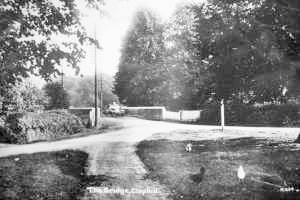
View from The Green. An early vehicle crossing the bridge and hens on The Green.
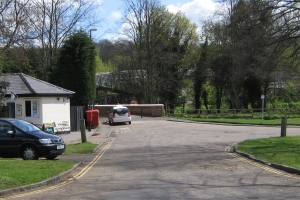
View from The Green. Usually crowded with motor vehicles.
St Mary's School
In 1871 the National Society (C. of E.) provided money to build schools to accommodate 185 infants and juniors. Clophill National School was opened by a short service on Friday 5th January 1872.
The new building has developed since 1973 and it remains a Voluntary Aided (church) school. Clophill became a Voluntary-Controlled Lower School for pupils aged 5 to 9 in 1975 and moved to a new building in 1976 in the High Street. All that remains of the old building is the bell tower in the grounds.
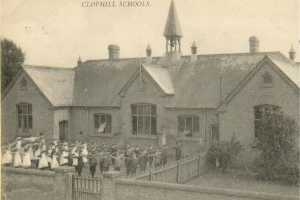
Children doing drill in the playground.
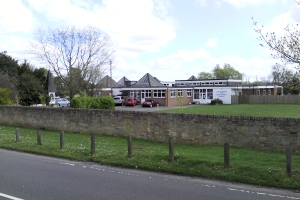
All that remains of the old school is the bell tower.
St Mary's Church
It was built in the Gothic style in 1848-9 and described by Nikolaus Pevsner as "an archaeologically convincing job, i.e. a church which the casual visitor might regard as genuine."
In 1964 dry rot was discovered and an extensive scheme of works over the next five years included re-roofing. For some reason, the nave clerestory was removed along with the crenellated parapet of the south aisle, completely changing the appearance of the church frontage. Presumably, this was done for cost reasons but it has left the building looking sadly utilitarian.
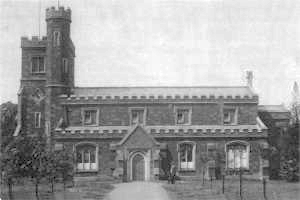
The original church showing the clerestory and crenellated parapet.
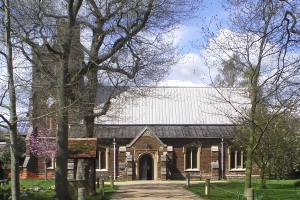
After necessary renovations to the roof.
Old St Mary's Church
Built in the Perpendicular Gothic style (i.e. from about 1350) the building comprised the chancel, nave, south porch and west tower. On completion of the new church in the High Street (1848) the old one was converted for use as a mortuary chapel as the graveyard remained open. In 1956 the lead was stolen from the roof and building was allowed to fall into ruin. (The old photo was taken C1900.)
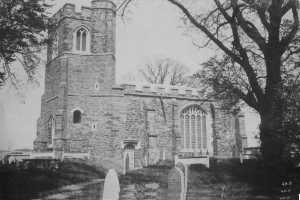
Note the large window, crenellations and the wooden grave boards.
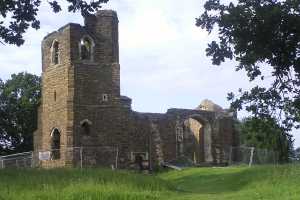
It was fenced off while restoration took place.
Old Forge
Next to the house in the High Street called the Old Forge used to stand a smithies shop. In the old photo you can see a circle on the ground which was used to put the metal tyres on to the wooden wheels. It is still there now.
A hundred years ago Arthur Cakebread was the blacksmith
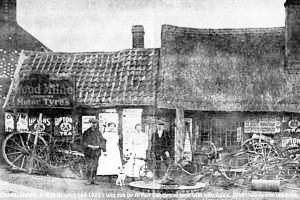
In the foreground is a circular tyring platfom, used for putting metal tyres on wooden wheels.
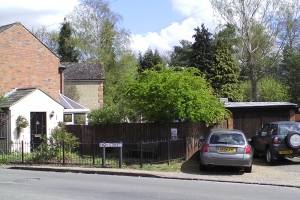
The Old Forge house is still on the left and under the gravel path is the old tyring platform.
Wesleyan Church
In 1814 a Wesleyan Chapel was built on the west side of the A6 (actually in the parish of Maulden but always called Clophill Chapel).
It was pulled down just before World War II in preparation for the new stretch of road which was eventually to carry the traffic away from Clophill Bridge.
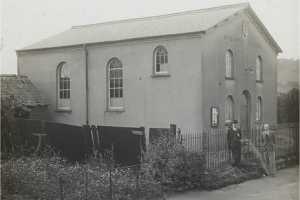
View looking north
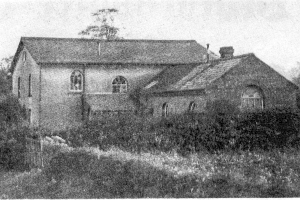
View looking south
Primitive Methodist Chapel, Silsoe Road.
In 1853 a Primitive Methodist Chapel in Luton Road (now Old Silsoe Road) was registered by John Symonds Gostling of Bedford, upholsterer.
The ex-chapel later served as a fire station during World War II and then as Chapel Feeds. It was recently demolished to make way for a new house (No 7 Old Silsoe Road)
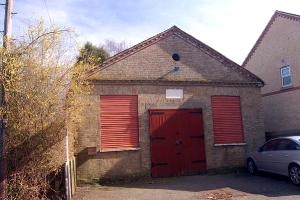
As it was before demolition.
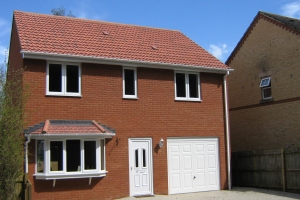
Replaced with a house.
Primitive Methodist Chapel, High Street
The "Primitive Methodists" built a new chapel in the High Street (next door to 53 High Street (the old Post Office) in 1915 and, apparently abandoned the old chapel.
The ex-chapel later served as a fire station during World War II and then as Chapel Feeds. It was recently demolished to make way for a new house (No 7 Old Silsoe Road).
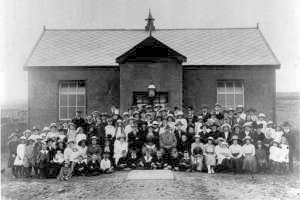
The congregation.
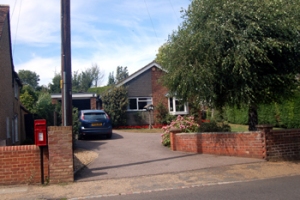
55 High Street
Parish Room
In 1906 a barn, in the grounds of the Rectory opposite the entrance to St Mary's Church, was converted to a hall. It was called the Parish room and, before the first village hall in Kiln Lane was built, it was the place for wedding receptions and many social functions.
It burnt down in 1966. As it was found that many of the timbers were rotten it was demolished.
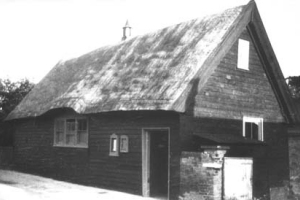
Parish Room.
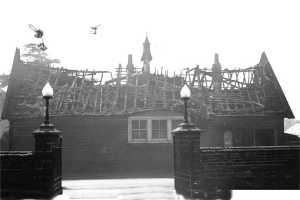
After the fire.
Reading Room
"The Reading Room was a great asset for village folk. Every evening it was open for billiards, snooker, cribbage or cards; but never on Sundays or Christmas Day. It was also used by the visiting Dentist as a surgery." Jack Pitts.
It was built in 1836 as a boy's Sunday school. When it became a 'Reading Room' is not known.
It was demolished to make way for a detached house.
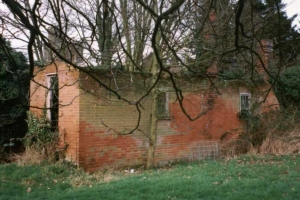
Reading Room
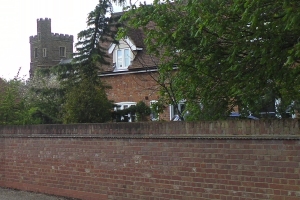
Modern house
