World War One - Recruitment
On the outbreak of war in August 1914, Britain had 247,432 regular troops. About 120,000 of these were in the British Expeditionary Army and the rest were stationed abroad. It was clear that more soldiers would be needed to defeat the German Army.
Volunteering
A man wishing to join the army could do so providing he passed certain physical tests and was willing to enlist for a number of years. The recruit had to be taller than 5 feet 3 inches and aged between 18 and 38 (although he could not be sent overseas until he was aged 19).
On his appointment as Secretary of State for War shortly after the declaration of the war, Field-Marshal Lord Kitchener issued a call for volunteers to increase the size of the army.
In August 1914 a new form of "short service" was introduced, under which a man could serve for "three years or the duration of the war, whichever the longer".
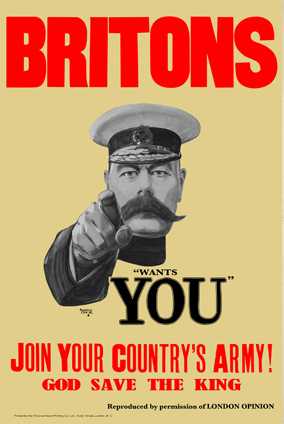
The Derby Scheme
On 11 October 1915 Lord Derby was appointed Director-General of Recruiting. He brought forward a programme five days later, often called the Derby Scheme although its official title was the Group Scheme, for raising the numbers. Men aged 18 to 40 were informed that under the scheme they could continue to enlist voluntarily or attest with an obligation to come if called up later on.
National Registration Act
By spring 1915 the flow of volunteer recruits was dwindling. The government, torn when it came to the question of compulsory military service, tried a half-way house scheme. The government passed the National Registration Act on 15 July 1915 as a step towards stimulating recruitment and to discover how many men between the ages of 15 and 65 were engaged in each trade. All those in this age range who were not already in the military were obliged to register, giving details of their employment details.
The results of this census became available by mid-September 1915 : it showed there were almost 5 million males of military age who were not in the forces, of which 1.6m were in the "starred" (protected, high or scarce skill) jobs.
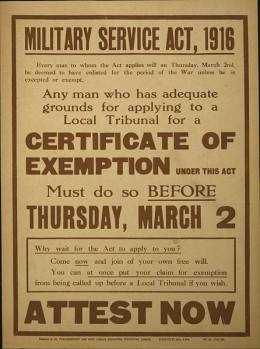
The Military Service Act 1916
Disappointed at the results of the Derby Scheme, the Government introduced the Military Service Act on 27 January 1916. All voluntary enlistment was stopped. All British males were now deemed to have enlisted on 2 March 1916 - that is, they were conscripted - if they were aged between 19 and 41 and resided in Great Britain (excluding Ireland) and were unmarried or a widower on 2 November 1915.
A system of appeals tribunals was established, to hear cases of men who believed they were disqualified on the grounds of ill-health, occupation or conscientious objection. Some trades were deemed to be vital to the war economy: the were called starred occupations.
Recruitment in Clophill
This is information gleaned from the 'Ampthill News' for the period of the war. Click title to expand an item.
Lord Kitchener, the war minister, began a recruiting campaign by calling for men aged between 19 and 30 to join the British Army. At first this was very successful with an average of 33,000 men joining every day. Three weeks later Kitchener raised the recruiting age to 35 and by the middle of September over 500,000 men had volunteered their services.
Three of the Boy Scouts - Alfred Jeffrey (16) *, Horace White (16), and William Sharman (15) have joined the Beds. Territorials. A few weeks ago Ernest Eddy (17), also a Scout, joined, and it is likely that two or three other Scouts will join very shortly. Perhaps some of the young men of the village, who have not yet seen their way to join H. M.'s forces will copy their example.
* The ages in brackets are based on their ages given in the 1911 census.
Percy Eddy (16) has joined the Beds. Territorials, making the total of Clophill Boy Scouts who have enlisted five.
No fewer than 56 men from this vicinity are serving in the various branches of His Majesty's forces, at home and abroad. This number embraces two Captains, Two Lieutenants, and 14 Non-Commissioned Officers. There are also the brave sailors of our village serving in the Royal Navy.
The National Registration Act 1915 provided for a register of all persons between the ages of 15 and 65, who were not members of the Armed Forces. The information supplied under the Act provided manpower statistics and also enabled the military authorities to discriminate between persons who should be called up for military service and those who should in the national interest be retained in civil employment.
The enumerators under the National Registration Act are six in number - Messrs. Burrows, Cunnington, Daniels, Robinson, Smith and Wootton.
On Wednesday evening, Col.-Sergt. Goodwin of the Duke of Bedford's Regiment, and other non-commissioned officers and men, held a recruiting meeting.
The scheme encouraged men to voluntarily register their name on the principle that once registered they would be called up for service only when necessary. As an added incentive married men were advised that they would only be called up once the supply of single men was exhausted. Announced in a fanfare of publicity the scheme proved unsuccessful however, and was abandoned in December the same year.
Sixty-six men connected with the parish are now serving in H.M.'s Forces, either at home or abroad. This number embraces a Colonel, a Major, two Lieutenants, and twenty non-commissioned officers. In addition to the above number there are the brave sailors of our village serving in the Royal Navy. The majority of those enlisted have given up good positions.
On Thursday evening, October 21st, a recruiting meeting was held on the Village Green, by Mr. Bubb, and was well attended. So far the meeting has had no result, although all the "eligibles" have not yet joined H.M. Forces. Another meeting was held at the Cross Tree (bottom of Great Lane) on Friday evening with similar results.
The spurt in recruiting, which last week was general throughout the country last week, was also in evidence here. In Friday, Messrs. Hubert Whittamore and Sam Titmas were enrolled in the Royal Flying Corps as mechanics (carpenters), and will be called up very shortly. On, Saturday, Mr. Walter Sharman joined the R.A.M.C., and proceeded to Eastbourne on Thursday, and Mr. William Bushby enlisted in the King's Royal Rifles. This is good, and it is to be hoped that other eligible young men will follow this excellent example. The total number of men now serving from Clophill is now 70.
Recruiting has been active during the past few days. Mr. Thomas Harris has been enrolled in the National Reserve, and is stationed at Ampthill. Augustus Webb and Bertie Rainbow, of Beadlow, on Saturday went to Bedford to join the Beds Yeomanry. Sidney Izzard and Percy Eddy have joined the Ampthill Park battalion. Harry Negus has enlisted in the Royal Field Artillery. Several others are enlisting this week.
The village is responding well to Lord Derby's appeal, the majority enlisting in the Duke of Bedford's Regiment. During the week ten have donned the khaki and seven others are almost persuaded. Pte. Herbert Harris is very energetic in his voluntary appeals and deserves encouragement.
A very small number of young single men remain who have not donned the khaki. Several have been rejected as physically unfit, and the majority of those enlisted have joined the Duke of Bedford's Regiment. Many letters have recently been received from the brave lads at the front, who are most anxious to receive Christmas gifts.
The Act specified that men from 18 to 45 years old were liable to be called up for service in the army unless they were married, widowed with children, serving in the Royal Navy, a minister of religion, or working in one of a number of reserved occupations. A second Act in May 1916 extended liability for military service to married men, and a third Act in 1918 extended the upper age limit to 51.
Men or employers who objected to an individual's call-up could apply to a local Military Service Tribunal. These bodies could grant exemption from service, usually conditional or temporary. There was right of appeal to a County Appeal Tribunal.
Messrs. Cecil Stimson and Sidney Matthews have attested under Lord Derby's Group System. Mr. Cecil Smith joined up on Friday last with his group, and has been sent to Tring to join the 5th Beds. Regiment. A few of the single men of the village have not attested so far, and are probably waiting to see if any further extension of time is likely to be granted.
Several applications were made on Monday to the Rural Tribunal * by attested men and their employers mainly connected with agriculture. A very small number of female labourers have at present volunteered their services, the more profitable employment of hat sewing attracting them.
* Military Service Tribunals were bodies formed by borough, urban district and rural district councils to hear applications for exemption from conscription into the British Army during World War I.
Several business men and others, attended the meeting of the Ampthill Tribunal on Monday, and the majority were afforded conditional exemption.
Several business men and others, attended the meeting of the Ampthill Tribunal on Monday, and the majority were afforded conditional exemption.
About a hundred Clophill boys have seen active service at one or other of the fronts, in addition to many who are at present undergoing training in England. At present there are 74 in the firing line, 10 sick or wounded and in hospital. One is a prisoner in Germany, eleven have given their lives, and two or three have been discharged as a result of their wounds rendering them unfit for further service.
Three of the village lads joined up on Friday - Ernest John Bushby has joined the Grenadier Guards, Reginald Grummit the Rifle Brigade, and Percy Jeffrey the East Kent Regiment.
Pte. William Sharman, Bedford Regiment, eldest son of Mr. and Mrs. Sharman, has re-enlisted for four years and is enjoying three months' furlough.
